

How we can stop adding suffering to loss
How a watch reminds me of a practice to reduce suffering

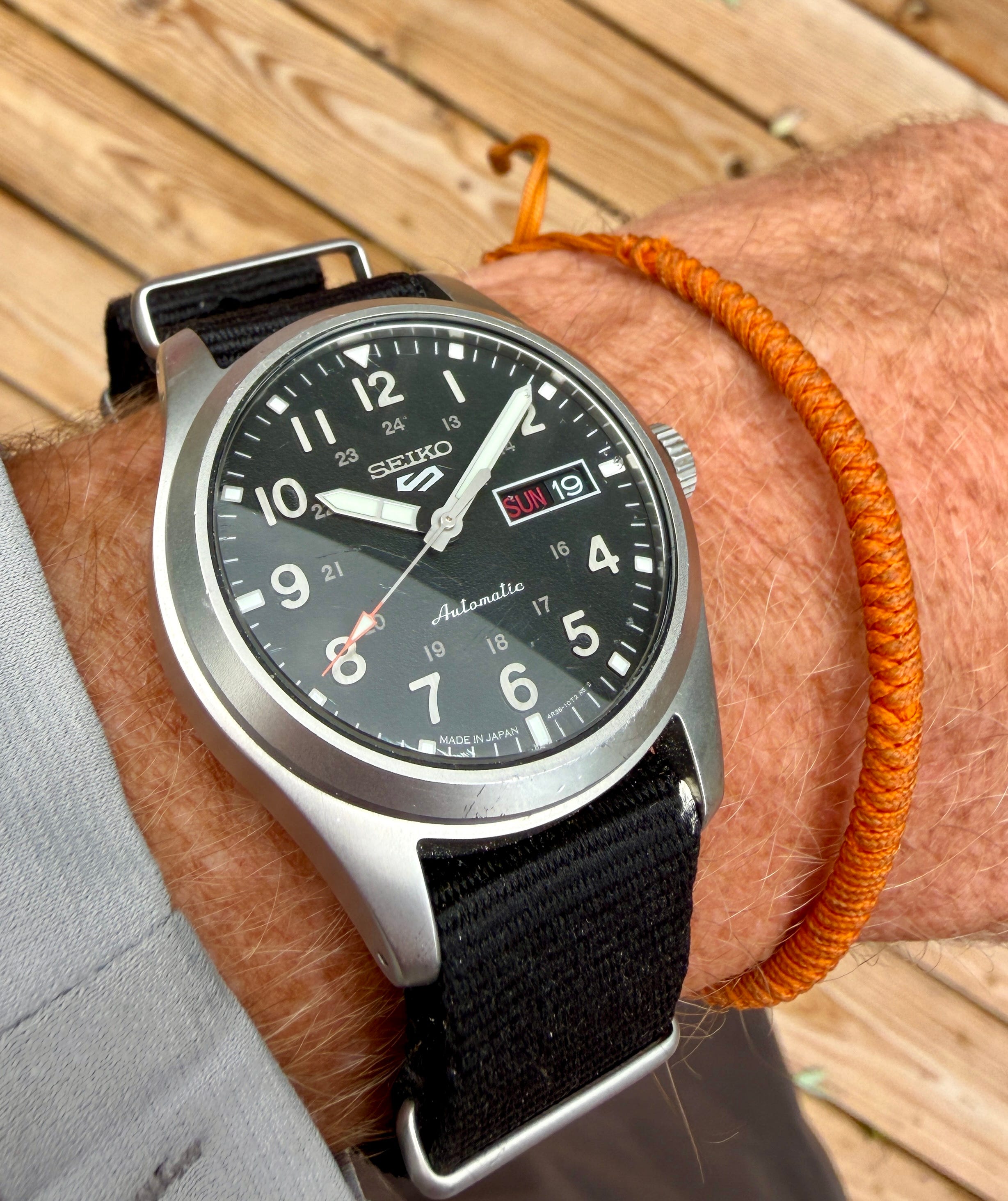
I was given a watch that doesn’t buzz. It doesn’t sync, ping, notify, or take my heart rate. In a decade when even the refrigerator wants to send us a message or sign up for an app, I’m wearing something of a relic. A mechanism that does exactly one thing, and only because I’m alive to feed it.
You likely know what an automatic watch is. I didn’t, until a few years ago. Most watches I’ve owned were quartz. That means a battery sends a tiny electric current through a crystal, which vibrates, and the watch counts those vibrations. It will keep perfect time whether I’m wearing it, sleeping, or dead. An Apple Watch impressively goes further still by not merely keeping time, but getting your texts, your heart rate, or the weather anywhere in the world. It needs you only to charge it, and after that, it runs on its own. An automatic has none of that. Inside is a small weighted rotor that swings loose on a pivot, catching the sway of my arm reaching for coffee or, ironically, for my phone, and turning that motion into a wound spring. And here’s the point, the automatic watch has no reservoir of its own. It only knows what time it is because something living is currently in contact with it. Take it off, set it on the dresser, and within about forty hours it just stops. The same way it will sit silently one day, on someone else’s dresser, or on a folding table at a yard sale. In that future moment it isn’t broken; it merely will be waiting for a wrist that isn’t mine.
It may seem bleak, but I don’t think that’s sad. I think it might be the truest thing there is to know. I don’t know the day, but it will be one day, someday.
Life is impermanence
I’ve been thinking of the slowing hands of this watch. Of the wrist it’s on. Everything is changing all the time. Whatever self I was wearing at twenty-five isn’t governing today. And the world can be thankful for that fact. My body is turning over its own cells as I write this sentence. Some of the convictions I’d have died for once, I no longer hold. Or hold differently.
There’s a word for this in Hebrew — “hevel” — usually translated “vanity” or “meaningless,” but it more literally means vapor. Breath. The mist off a pond on an autumn morning. It’s there, but it’s formless. It won’t hold a shape long enough for your hand to close around it. “Hevel” or “havelim”, says the ancient teacher who wrote Ecclesiastes: everything is vapor. Not “everything is worthless” or can’t be held, but that everything is unfixed. The idea is usually sermonized very flatly as ‘life is short’, but it’s really about the nature of this life no matter how long.
Thinking about this is a gift.
We add suffering to loss. Loss is inevitable; suffering is negotiable. There’s an ancient way to describe this, and it’s called the second arrow. The first arrow is losing something; we don’t get a vote on that one. The second arrow is the demand that things don’t change. That the body not age, or loss doesn’t touch our lives. This kind of clinging doesn’t prevent loss. It only taxes it with a suffering that can make reality crushingly unbearable.
Our hopes and prayers
If I’m honest about my own prayers — not just my theology, but the actual shape of what I ask for, twenty-some years into pastoring people through the worst weeks of their lives — I think this is the diagnosis: the lion’s share of our prayers are oriented toward changing reality, rather than meeting reality with the trust that we have hope in it and beyond it. In a sense, we ask God to hold the watch still. Which, if we’re moving and alive, is not in the offering.
Hey pal, isn’t this a little cruel?
I can feel the objection forming, because I’ve felt it forming in myself. Isn’t it unkind to tell someone they’ll get sick, lose what they love, run out of time with the people they’d give anything to keep? But it would be way more cruel to never think about these things. Or to build out our entire prayer lives to prevent them. Worse still to say our prayers themselves are ineffective when loss happens. How many people have left the faith for that very reason? Assuming they simply aren’t good at prayer or it wasn’t effective in changing reality.
So, is this article cruel? What I’ve come to believe, hearing people pray, is closer to the opposite: it is not the naming of impermanence that produces despair. It’s the unnamed dependence on permanence, quietly running underneath everything, that does. The person who has never once rehearsed the fact that this will end is not protected from the ending. They’re only unprepared for it — and when it comes, as it comes for everyone, it doesn’t arrive as sorrow alone. It arrives as betrayal. This wasn’t supposed to happen. But it was always going to happen. We just never practiced believing it. We were told to pray for its reversal. And if we prayed or fasted, we’d see the reversal.
So the crueler thing, I’ve come to think, is the silence. Consider it a mercy, then, not a warning: to visit our own impermanence on purpose, before it visits us.
A practice, not a punishment
This doesn’t need to be morbid. It can be as small and routine as winding your watch.
Some traditions have a name for this rehearsal — sitting, briefly and on purpose, with the facts of the body’s fragility, the people we love, the things we own, none of which are ours to keep.
Once a week (Sunday evening works, if you want a rhythm), sit for two or three minutes with three sentences, slowly:
My body will age and fail. This is not a flaw in the design; it is the design.
Everyone I love, I will one day lose, or they will lose me. This is not a tragedy waiting to happen; it is already happening, gently, today.
Everything I’m holding onto: old baseball cards, reputation, certainty, the way things are, is on loan. It was never mine to keep still.
You’re not trying to feel bad. You’re trying to feel accurate before the accuracy arrives as an unwanted guest. The goal isn’t despair; it’s facing the coming and unavoidable reason for your despair on your own terms. On a Sunday evening, voluntarily, instead of ambushing you on a Tuesday at the hospital.
Valuing the present
Our eldest son gave me this watch. It won’t tell me someone has texted. It tells me time is passing while they still do for now. And while there’s endless advice to slow down and enjoy the moment, what we often miss is an actual practice for doing it.
Be well, friends.